
By Laura N. Sarchet
Strategies to Support Children with Disabilities
Social and emotional development, essential to everyone’s well-being, describes the skills children and adults need to self-regulate and participate in social relationships. When children develop social and emotional skills, they experience positive effects in later life, including a general sense of wellness, increased quality of life, and self-empowerment. While all children need support in their social and emotional development, explicitly teaching these and related skills, such as self-advocacy, may especially benefit children with disabilities.
According to the Collaborative for Academic, Social, and Emotional Learning (CASEL), social and emotional development has five broad components:
· Self-awareness
· Self-management
· Social awareness
· Relationship skills
· Responsible decision making
Skills that support social and emotional development and self-advocacy can be part of an intentional curriculum in preschool and early elementary settings. Self-advocacy is essential to social and emotional development. While not one of the five components of social and emotional development according to CASEL, self-advocacy skills are related and aligned with social and emotional learning. A child with strong self-advocacy skills knows their own strengths, needs, preferences, and interests. They recognize when to share this information, and they know how to communicate their needs effectively in a way that supports themselves and those around them.
But children need time, opportunities, and support to develop self-advocacy skills. While all children and adults need these skills, self-advocacy is especially necessary for individuals with disabilities. Children with disabilities may have differences in the ways they communicate and learn. When they get older, these children will be a vital part of their own transition process from school and other educational spaces to advocating for accessibility in the workplace.
Educators can incorporate these skills into other activities already happening in their groups or classrooms, such as during read alouds, pretend play, and social studies or community education. No matter how they do this, educators consider children’s individuality when supporting social and emotional development. Some children may develop these skills rapidly and more independently; other children may need more explicit teaching.
I am an autistic self-advocate. I was a special education teacher in both early childhood and middle-grade settings before starting to work in higher education as a special education teacher educator. While working with children with disabilities, I taught them many strategies that were useful in my own journey. I eventually developed these skills into a curriculum called Self-Advocacy in Action. Initially created for middle school students on the autism spectrum, this curriculum was later adapted for all ages of children.
In this article, I describe how educators can help children with and without disabilities use self-advocacy to support each component of social and emotional development. The following vignette is based on my experiences in the early childhood classroom. Each of the five components of social and emotional learning is aligned to self-advocacy skills as represented in the vignette, providing examples of how educators can support preschoolers and kindergartners in this area.
Modeling Self-Advocacy Skills to Support Social and Emotional Learning
Avery, an outgoing child who enjoys greeting her friends and teachers with hugs, runs over to Cam, another 4-year-old in her class. She wraps her arms around him in a friendly hug as she arrives in the classroom. Their teacher, Mrs. Hassan, notices that Cam, a child with autism spectrum disorder, doesn’t outright reject Avery’s display of affection, but he shrinks away and grimaces.
Mrs. Hassan wonders if Cam is uncomfortable with this physical touch. She has observed that he covers his ears during music time and never seems to get enough of the water table. She has also observed that Cam loves to look at books, usually by himself, and he excels in helping with the classroom calendar. Avery, on the other hand, likes to sing along at circle time and prefers reading books with others. She excels at gathering the other children to play together.
Mrs. Hassan pulls Cam aside after Avery returns to the block area, and asks, “Do you like to get hugs from friends?” Cam shakes his head no and squeezes his eyes shut.
“That’s okay!” Mrs. Hassan reassures him. “You can still be friends and say ‘No, thank you’ to hugs.”
In the above vignette, Cam demonstrated coping with his discomfort: He tolerated a physical greeting even though he didn’t like it. Mrs. Hassan recognized that Cam needed support building self-awareness around his own sensory needs and his feelings. She also observed that Cam might have needed support to express his concern to Avery or other children. She wanted to help Cam start to notice his own likes and dislikes, which would help him understand and navigate his own strengths, needs, preferences, and interests.
To help build Cam’s self-awareness, Mrs. Hassan asked him a yes/no question about this social and physical interaction (“Do you like to get hugs from friends?”). Educators can also use open-ended questions (“How do you like to say hello to a friend?”) or present options (“Would you like to hug, high-five, say hi, or wave?”) to support children’s self-awareness skills. Intentional educators understand the importance of scaffolding questions based on children’s communication needs to address self-advocacy skills and social and emotional learning. They also consider children’s contexts and individual strengths and needs. This aligns with the guidelines in NAEYC’s position statement on developmentally appropriate practice, including those related to teaching practices and curriculum.
When Mrs. Hassan asked Cam if he liked getting hugs and validated his negative response, she showed him it’s okay to feel uncomfortable and to express that discomfort. Educators can encourage self-advocacy in young children by acknowledging that all feelings (including dislike or discomfort) are valid and by teaching self-management strategies that promote children’s agency. These strategies can include
· Naming emotions and teaching children to identify their feelings
· Asking questions with curiosity
· Validating children’s emotions
· Providing options for problem solving
· Differentiating between feelings and behaviors
Educators can also teach children that it is okay for them to change their minds or to want different things at different times. For instance, Mrs. Hassan recognized that Cam may like physical touch in some instances but perhaps not unexpectedly. Cam could also want a hug from Avery or another peer on some days but not others. Children should have the ability to make choices based on their likes and dislikes. Knowing how to communicate those different feelings across situations, or even just separate instances, is a facet of self-advocacy.
Mrs. Hassan also helped Cam develop relationship skills through self-advocacy. Relationships, like preferences and needs, can be tricky to navigate and involve complex understandings of contexts. Mrs. Hassan helped Cam understand that two things can be true: We can be friends with someone and also tell them no. Setting boundaries is an important relationship skill for young children, older children, and adults.
Cam opens his eyes. Mrs. Hassan smiles and says, “Let’s practice.”
She points to the red sign on the laminated visual support card Cam is familiar with using. “When you don’t want a hug, you can say no with your voice or your pictures.”
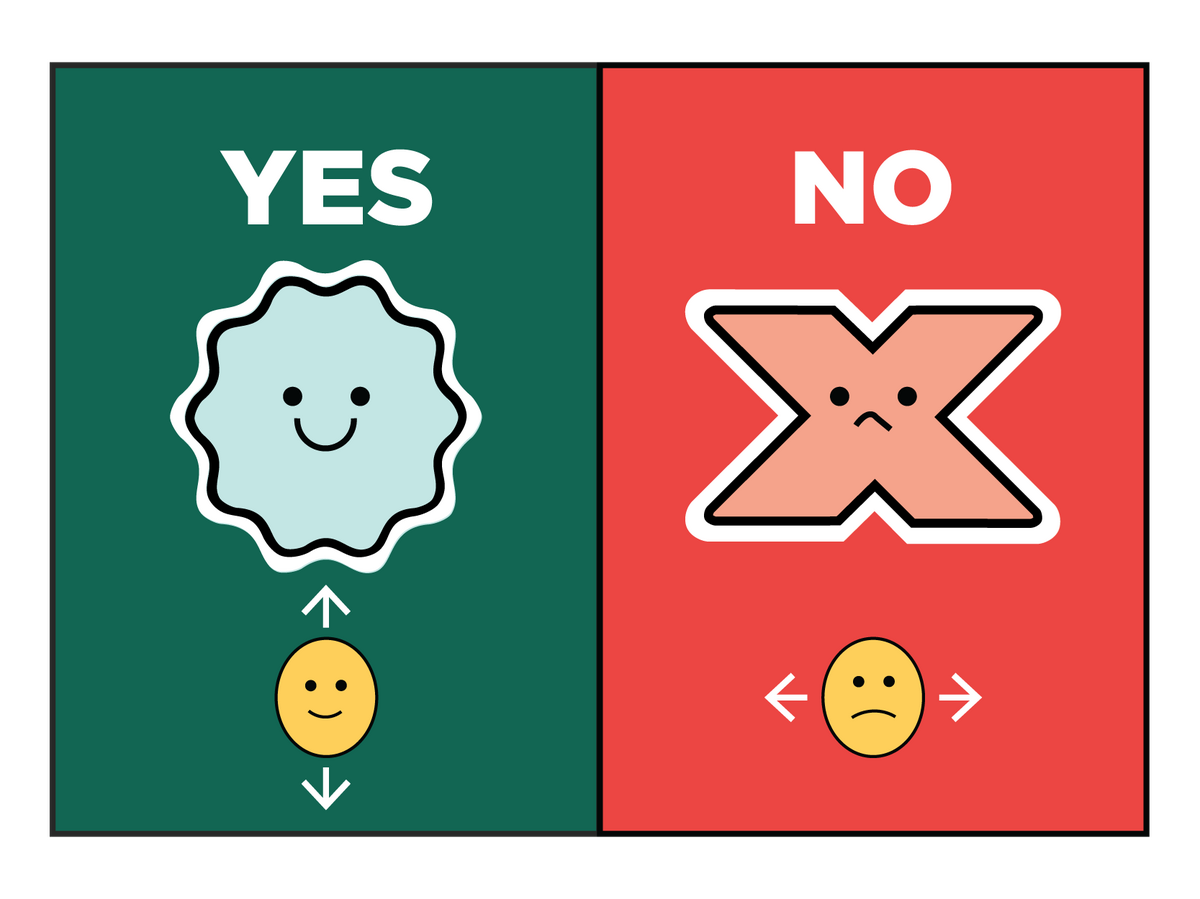
Mrs. Hassan models again. Then she gently takes Cam’s hand and helps him touch the red “no.”
Cam whispers, “No hug.” He smiles to himself and skips over to play at the water table, taking the laminated card with him.
Cam made a decision and acted upon it when he communicated his no. Another component of social and emotional development is responsible decision making. Educators scaffold and teach children how to problem solve and choose between options to make decisions.
One way to do this is to provide children with options. Cam may not have realized that he had the choice to refuse a hug. Mrs. Hassan used his choice card, a familiar visual support, to give Cam specific options. In this way, she helped him to build self-advocacy skills, strengthen his decision-making power, and promote his responsibility toward himself and others.
Decisions also have consequences. Young children begin to learn the cause-and-effect nature of each choice through trial and error, such as when an infant’s crying causes a caregiver to feed or comfort them. Mrs. Hassan knows that children continue to develop their understanding of decisions and consequences throughout their interactions in school, with adults, and with peers. She supported Cam by affirming that his no to a hug would be respected in their learning community.
The next morning, Avery attempts to greet Cam with another enthusiastic hug. Cam steps back, and his eyes search for Mrs. Hassan. She hurries over and gestures toward the laminated card. Cam touches the visual support and softly squeaks “No hug” as he backs up farther from Avery, who looks, confused, between Cam and Mrs. Hassan.
“That’s okay,” Mrs. Hassan says. “Cam was advocating for himself, and he said no thank you to a hug right now. But you could still ask if he wants to play with you.”
Not only did Mrs. Hassan teach Cam how to appropriately advocate for himself, but she also modeled how Avery could respond by honoring Cam’s choice. This built upon both Avery and Cam’s different social skills by allowing each of them their own choices while considering others too. It also shows how educators can differentiate instruction for each child.
Over time—and with intentional guidance—Cam and Avery will learn to balance the consequences of their decisions between self-advocacy and social relationships. A consequence of Cam’s answer might be that Avery is initially disappointed to miss out on a hug from her friend. However, Avery and Cam will continue to positively interact with each other while respecting each other’s advocacy and boundaries.
Avery turns and says to Cam, “Hey, wanna play water table?”
Cam jumps, waves his picture card in the air, and announces, “Yes!” He and Avery dash away, ready to play.
Incorporating Self-Advocacy in Your Setting
Self-advocacy is an important skill not only for children with disabilities, but for everyone. The early childhood years are not too early to start learning how to advocate for themselves! Early childhood educators have a terrific opportunity to model and teach self-advocacy skills while also supporting every child’s social and emotional growth. Here’s how you can intentionally incorporate self-advocacy skills, including with children across age groups.
· Intentionally observe children’s strengths, preferences, and interests as well as needs and challenges. Look for ways to build upon a child’s favorite activity, or use an already strong skill by helping them to communicate what they like and how they like to do it. Similarly, noticing a struggle that a child has can lead to an opportunity to teach them to self-advocate.
· Provide options to the whole class. For instance, talk about ways to greet and respond to each other during a whole-group meeting, giving language and options that all learners can use. Couple this with individualized support as needed for specific children and situations.
· Don’t try to solve every problem immediately. Once children have been taught how to use a particular self-advocacy skill, allow them to experience a small amount of discomfort or tension in certain situations. Pause and observe how children explore different ways to solve their own (small) problems, and give them space to ask for help and practice independence with their self-advocacy skills.
Further Resources
The following resources can help educators support children’s social and emotional development.
· The CASEL Framework. Updated 2020. A multidisciplinary network that includes researchers, educators, practitioners, and child advocates, CASEL strives to make social and emotional learning available to all students.
· Young Children, Spring 2025. This issue of Young Children focuses on transforming our understanding of and approaches to children’s behavior. It examines how educators can respond to children’s behaviors in ways that are aligned with developmentally appropriate practice and equity.
· Educating Young Children, Summer 2025. The Summer 2025 issue of Educating Young Children centers the idea of educator well-being, exploring how educators can practice self-care and self-regulation techniques.
· Spotlight on Young Children: Social and Emotional Development, by Marilou Hyson. NAEYC, 2023. This book explores how teachers can use the opportunities embedded in their curricula, practices, and routines to support positive, healthy behaviors in children from birth through age 8.
Reflection Questions
· What connections do I see between self-advocacy and social and emotional learning?
· What strengths, interests, and communication styles do I notice in the children in my setting? What needs and challenges do I notice them having?
· What activities can I plan to teach all children options for communicating their interests, needs, and preferences?
· How can I differentiate activities and materials for individual learners who might need more support?
About the Author
Laura N. Sarchet, PhD, is an assistant professor of special education at Niagara University in Lewiston, New York. She is an autistic self-advocate and former special education teacher who uses her experiences to raise awareness about autism and disability through research and practice.
NAEYC Accreditation
This article supports the following NAEYC Early Learning Programs standards and topics.
Standard 1: Relationships
Creating a Caring and Equitable Community of Learners
Standard 3: Curriculum
Planning and Implementing an Engaging Curriculum to Meet Meaningful Goals
Standard 4: Teaching
Teaching to Enhance Each Child’s Development and Learning
Photograph: © Getty Images. Copyright © 2026 by the National Association for the Education of Young Children. See permissions and reprints online at NAEYC.org/resources/permissions.