Reflections on Growing as an Early Childhood Professional
Editors’ Note
As NAEYC marks 100 years of advancing early childhood education, the Year of Reflections storytelling initiative invites educators, advocates, and leaders across the field to look back on the journeys that have shaped them as early childhood professionals. In this issue’s edition of Educator Voices, three contributors to this initiative share how they have grown in the early childhood field. They were selected to represent a range of roles, regions, and career stages. Each story has been edited for length and clarity.
Seek Out Mentors
I arrived in the United States from Ukraine in April 2022, beginning my life and career in an entirely new country. As a newcomer, everything felt unfamiliar: The language, the systems, and the professional expectations. Even though I came with a strong love for children and prior experience in education, I quickly understood that early childhood education in the United States has its own philosophy, standards, and practices that I needed to learn with humility and openness.
Community college became my true beginning in the US early childhood field. Through my studies, I earned my site supervisor permit, but more importantly, I gained confidence and a sense of direction. I was fortunate to learn from instructors who did far more than teach course content. Educators patiently guided me through the nuances of US preschool education: Developmentally appropriate practice, observation and documentation, family partnerships, and ethical responsibilities. They took time to explain not just what we do as educators, but why it matters.
As an immigrant, feeling that I belonged was not automatic. It was mentorship that made the difference. My teachers’ encouragement, clarity, and belief in my potential helped me see myself as a professional who had something meaningful to contribute, even while still learning a new system.
Today, working in a preschool, I am deeply inspired by the children I teach. I admire their curiosity, resilience, and openness to the world. Every day, they remind me that early childhood education is about relationships, trust, and growth—both for children and for educators. Supporting their learning and emotional development is a responsibility I hold with great respect.
My beginning in US early childhood education was shaped by mentorship, generosity, and shared knowledge. Because of the mentors who welcomed me and guided me, I strive to create the same sense of belonging, patience, and encouragement for the children and families I serve.
—Yuliia Kaliuzhna, lead teacher at a child care center in San Francisco, California

Joyfully Engage with Children and Colleagues
I began my career in early childhood education believing I was choosing a profession. Looking back, I realize I was finding my purpose.
Over the past two decades, my journey has taken me from classrooms to early childhood principalships, from Head Start programs to state government, from university classrooms to community-led initiatives focused on improving outcomes for children and families. Along the way, I have had the privilege of helping shape programs, influence policy, support educators, and advocate for systems that better serve young children. Yet when people ask what has brought me the greatest joy, my answer is always the same: People.
The joy has been in watching a child who struggled find their voice. It has been in seeing an educator discover confidence in their own leadership. It has been in sitting with families who simply wanted someone to believe in their child as much as they did. It has been in witnessing entire communities come together around a shared commitment to give children a better start than they had yesterday.
The wisdom I carry with me was passed down by people whose names may never appear in a research study, policy report, or history book. It came from educators opening their classrooms before sunrise, directors stretching impossible budgets, grandparents raising grandchildren, and families doing everything they could to create opportunities for their children. They taught me that early childhood education is not simply a profession; it is an act of hope. Every day, we choose to believe in a future we cannot yet see.
As I reflect on this profession and NAEYC's centennial celebration, I find myself thinking about the thousands of children, families, educators, and colleagues who have crossed my path. While I cannot remember every meeting, presentation, initiative, or policy discussion, I remember faces. I remember stories. I remember moments.
I remember the child excited to show me they had finally learned to write their name. I remember educators who stayed long after their shifts ended because a child needed them. I remember families who trusted us with what mattered most to them. Those moments never leave you.
If this profession has taught me anything, it is that our impact is often invisible in the moment. We may never fully know how a conversation, a classroom, a relationship, or an act of kindness shapes a child's future. But I believe it does.
And that is why, after all these years, I still love this work.
Because every day, in ways both big and small, we are helping write the first chapters of someone’s story.
—Thomas Williams Jr., director of programs in Louisville, Kentucky

Advocate for Yourself and the Profession
I went to college as a premed major and was putting myself through. So I found a work-study job at a parent co-op infant and toddler center. This was the early 1980s, and the parents were mostly graduate students or professors at a time when women were gaining ground in academia and the workforce. The other teachers and directors saw this as social justice work—feminist work. I loved the work, the children, and the mission. I switched my major to child development and worked at the center all four years and joined the board my junior year.
After a master’s focused on the impact of infant child care, I began a career as a program manager with very low pay. My director saw something in me and encouraged me to join the local AEYC Affiliate and present at their workshops. This brought me to so many smart, committed early childhood education professionals and helped me see beyond the joys and riots of the toddler classroom—and reflect on my practice.
The developmentally appropriate practice book also has a profound impact, giving clear guidance about how to best support child development. I still keep a copy of Reaching the Full Cost of Quality in Early Childhood Programs in my office to keep worthy wages top of mind. We know what it costs: Let’s get there! The Worthy Wage campaigns at NAEYC conferences also had a profound impact on my path. I stayed engaged and ended up as president of Connecticut AEYC (CTAEYC), putting on conferences with a team of folks.
I got involved with advocacy through NAEYC and Public Policy Forum in Washington, DC. It was so exciting and challenging due to the low status of the field and low pay. But the connections to NAEYC and CTAEYC are what kept me in the field and advocating. Those lessons in advocacy are part of why I ran for the local school board (to add early childhood education to the district), the state legislature, and the state senate—serving for 14 years in the Connecticut General Assembly until the governor appointed me commissioner of early childhood.
Throughout my career, NAEYC has been at my side.
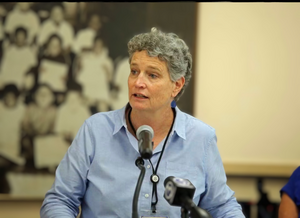
—Beth Bye, early childhood education advocate and policy specialist in West Hartford, Connecticut
Want to Learn More?
These reflections were submitted to NAEYC’s Year of Reflections as part of the organization’s centennial celebration. Contributors were selected to represent a range of roles, regions, and career stages across the early childhood education field. Each story has been lightly edited for length and clarity.
Check out Year of Reflections: A Century of Impact to learn more about the initiative.
Photographs: courtesy of authors. Copyright © 2026 by the National Association for the Education of Young Children. See permissions and reprints online at NAEYC.org/resources/permissions.