
By Iliana Alanís and Irasema Salinas-González
Supporting Educators of Multilingual Learners
As of 2026, about one in three preschool-age children in the United States is a multilingual learner, meaning they are growing up speaking a language other than English at home. Given this growing population, many early childhood educators continue to seek effective ways to support this group’s linguistic, social, and academic development. However, instruction for emergent multilingual learners remains underrepresented in professional learning. This situation creates both a challenge and an opportunity to better support multilingual children from their earliest years.
For the past three decades, we (the authors) have partnered with preschool-to-grade-5 dual language educators to implement high-quality bilingual programs. More recently, we’ve focused our work on preschool classrooms, where professional learning in this area is often limited. We’ve found that preschool teachers are often well-versed in research-based strategies, such as open-ended questioning. But many wonder when and how to apply language development strategies throughout the day with young multilingual children.
In this article, we show how professional development can help educators grow in teaching multilingual learners. We provide examples taken from our own work in a school district, described in “Our Context and the Interdisciplinary Biliteracy Sequence” below. We present ways that program administrators can work with preschool educators of multilingual learners to replicate the ideas in their own settings. Although these strategies can be implemented in any preschool program, they’re crucial for scaffolding multilingual learners and drawing on their skills across languages.
Our Context and the Interdisciplinary Biliteracy Sequence
From May 2024 to May 2025, we partnered with a school district along the Texas-Mexico border in the Rio Grande Valley as it shifted toward a more cohesive and strategic approach to bilingual language development. In this district, bilingual programs are common and include children growing up speaking Spanish or Spanish and English. The district also includes children from English-only speaking homes.
To address the unique needs of their setting, the early childhood and bilingual education directors assembled a leadership team of five lead preschool teachers across the district who teach multilingual preschoolers effectively. Two instructional strategists, one specializing in early childhood and the other in bilingual education, also joined the team.
Central to this approach was integrating a three-phase instructional framework called the interdisciplinary biliteracy sequence into everyday practice. This framework is designed to strengthen vocabulary, bilingualism, and early biliteracy through inquiry-based learning (phase 1), shared writing (phase 2), and interactive read alouds (phase 3). The sequence ties together with thematic learning centers, ensuring that instruction remains integrated, purposeful, and grounded.
We found that this sequence helps educators
Tailor their practices to multilingual learners
Create engaging, culturally sustaining, and language-rich activities
Promote purposeful and playful learning experiences that are academically meaningful and responsive to children’s cultural and linguistic needs
Rediscover enthusiasm for teaching by focusing on creativity, cultural relevance, and child engagement
For more information about the sequence, see The Essentials: Supporting Dual Language Learners in Diverse Environments in Preschool and Kindergarten, by Iliana Alanís and colleagues, as well as “Teaching and Learning in the Outdoors: Nature as a Springboard for Biliteracy Development,” by Maria G. Arreguín and Rica Ramírez in the Summer 2025 issue of Young Children.
Fostering Strong Language Development
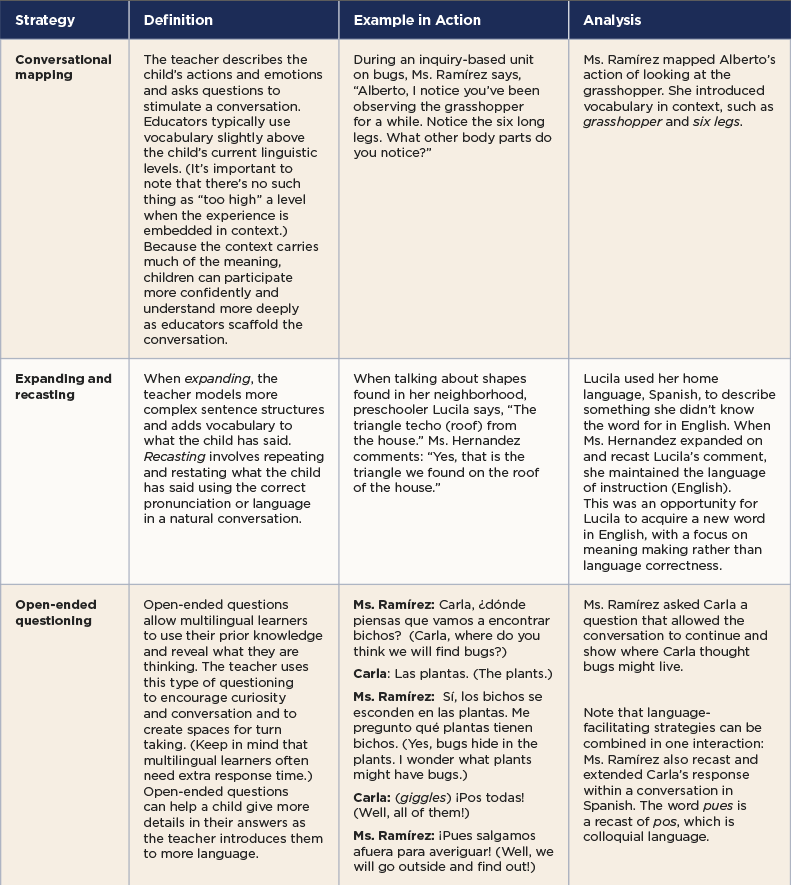
Language growth flourishes when adults thoughtfully tune in, respond to, and build on children’s growing language skills. Educators use several strategies to do this, such as conversational mapping, extensions and recasting, and open-ended questions (see “Language-Facilitating Strategies: Definitions and Examples” below for more information).
There can be several challenges to nurturing language development. An educator may not speak the same home language(s) as the children they teach, which can lead to miscommunication and feelings of frustration both for teachers and children. Though a team of educators may be bilingual, the degree of language proficiency may differ from teacher to teacher. Lastly, educators may not feel adequately supported by existing professional development. We share practices to address all these situations.
Language-Facilitating Strategies: Definitions and Examples
Educators can use several strategies to effectively support language development and conversations with multilingual learners. These strategies can also be used in any preschool setting and in any language.
Introducing Effective Professional Development
Fostering a supportive professional growth system for preschool teachers is a top priority for the directors we have worked with. Key principles that guide this work include establishing collaborative learning communities and a strengths-based perspective.
Create Collaborative Learning Communities
Collaborative learning communities are spaces where participants share their experiences, strategies, and resources and build knowledge. Educators learn from each other’s strengths and challenges as they solve problems together. It’s particularly important for administrators to cultivate this space with early childhood educators. Many often have questions and are unsure about individualizing practices for multilingual learners.
At the start of the year in our partnership with the Texas district, the teacher leadership team met once every two weeks with instructional strategists to collaboratively plan lessons, share ideas, and develop support strategies for implementation. But that wasn’t all. Lead teachers also engaged in weekly informal, relationship-based dialogues known as pláticas with their colleagues. (For more information on pláticas, see “Using Pláticas as an Inclusive and Responsive Approach in Early Learning Settings” by Julia Guadalupe Cuevas Guerra in the Summer 2024 issue of Teaching Young Children.)
These districtwide learning communities encouraged honest, open discussions among preschool teachers about their work, revealing their vulnerabilities and prompting questions and reflection. The directors and strategists participated in the groups too, demonstrating a shared commitment to growth and fostering trust. As a result, teachers felt supported in taking risks and refining practice.
For example, teachers had created rich, inquiry-based experiences in which children encountered concepts such as gliding and spinning leaves and pumpkin textures, like ribs and prickly stems. Through reflection and conversation within the groups, they recognized missed opportunities to develop descriptive language connected to these experiences.
While other settings may not have the same roles or resources as this district, administrators can encourage teachers to create informal learning communities that provide a space for open communication, such as after-school pláticas. Another option is for leaders, coaches, or mentors to set aside time during existing meetings with preschool educators, perhaps once a week or once a month, to invite them to share their experiences and ideas. We recommend 30- to 60-minute sessions, but the group can determine what works best for their context. Creating a space of trust, exchange, and openness for all participants will benefit educators and their multilingual learners in the long run.
Use a Strengths-Based Perspective
Just as teachers are called to focus on children’s strengths, those who support educators can do the same. By highlighting what educators are already doing right, they can then position inconsistencies less as mistakes and more as opportunities for continued growth. For example, an educator may already include labels in their classroom environment in children’s home language(s) and in English. Building upon that, a mentor could suggest planning times throughout the day in which children look around the room for words in different languages related to a theme (reading the room). As teachers continue to reinforce their strengths and refine their practices, their implementation will become more consistent, and their confidence will grow.
After identifying what teachers have done well, mentors can guide them to see how it influenced multilingual children’s learning by using specific language, like “I noticed you were expanding and recasting what children were saying. This supports children’s learning by providing the language we want them to adopt in a natural conversation.” Explaining why the technique works is equally as important as addressing what it is and how to do it.
Putting Professional Development into Practice
Once the foundation has been laid, professional development can focus on promoting targeted discussions and individualizing classroom support for teaching multilingual learners.
Facilitate Targeted Discussions
Too often, professional development consists of blocks of time in which information is directed at teachers, with little time to process it. Creating targeted moments of learning helps teachers reflect on the new information and how it connects to their current practices. Progressing slowly gives teachers time to build confidence and deepen their understanding step by step. This is especially crucial for educators who are new to teaching multilingual learners.
In our partnership, we developed three 90-minute after-school sessions with the collective group of bilingual preschool teachers. These were spaced out over the school year in December, February, and April. Educator feedback from previous experiences informed us that this was the right amount of time between sessions for educators to integrate new strategies into their practice.
Our goal was to build on the strategies we had initially introduced over a summer training. These strategies were simple to model, easy to implement, and immediately useful in the classroom. Each session focused on a new strategy: Conversational mapping, extensions and recasting, and open-ended questions. We used multimodal methods to provide teachers with time to learn with and from each other to incorporate the strategies into their practice. These included
Role-play scenarios: Together, teachers acted out interactions that included conversational mapping, extensions and recasting, and open-ended questions. This allowed them to practice how to apply the linguistic scaffold in an authentic learning situation. Role-playing can be especially helpful for those who do not speak the children’s home language(s).
Photo and video analysis of educator practice: Reflecting on recordings opened up conversations in which teachers walked through what they did when using a strategy and how it impacted children’s engagement and learning. Even when teachers do not understand the language spoken in the videos, they can observe nonverbal gestures, displays of children’s excitement, and signs of scaffolding, such as the use of visual aids.
Cooperative learning strategies: These included reading jigsaws, think-pair-shares, and partner-based activities, all of which offer teachers opportunities to talk, process, and learn from each other. Engaging in these activities provided a nonjudgmental space in which educators could explore new approaches and ways of implementation.
Program leaders, coaches, or mentors can model these practices during one-on-one, small group, or larger professional learning sessions. Teachers can then reflect on and discuss what they observed. Photo and video documentation can further support reflection by helping them notice how they use specific language strategies with children. These multimodal methods can be adapted for programs of any size or language and can nurture educators’ growth in teaching multilingual learners.
Individualize Classroom Support
After each targeted discussion, teachers can implement the selected strategy with their multilingual learners before the next professional development meeting. This is a time when a program leader, coach, or mentor can observe and offer individualized feedback.
In the district we worked with, instructional strategists asked teachers to identify areas of focus for their observations. Some teachers wanted the strategists to capture the language they were using with multilingual learners and when they were using it. Others asked to be recorded, so they could watch the recordings together and discuss. Some only asked for general feedback. In all cases, strategists tailored their observations and feedback based on each teacher’s strengths, concerns, and needs.
Strategists also used modeling. For example, Leti, a bilingual instructional coach, described how she modeled open-ended questioning:
During the read aloud, I noticed the teacher was asking basic recall questions. I asked her if it was okay for me to read with the children. I paused at various points for children to turn and talk about a question I had posed. For example, I would say, “Why do you think the very impatient caterpillar is so anxious to get out of the chrysalis? Turn to your partner and talk about it.” Children immediately started talking. After the read aloud, I talked with the teacher about her thoughts. She just needed a little help adjusting her questions to encourage lengthier responses from the children.
Modeling helps bring strategies to life: It shows what each strategy looks and sounds like and how it affects children’s engagement and learning. When teachers feel the strategy is feasible to implement, they are more willing to try it and learn through the process, regardless of their proficiency in the child’s home language. The trust built from creating a collaborative learning community is integral to this mindset shift.
Capture Insights and Plan Next Steps
As educators try new practices, it’s important to summarize key takeaways and identify how they will continue to refine or expand these strategies. Reflection is essential for sustained growth and requires ongoing feedback and dialogue through professional development.
In our case, after we reviewed what teachers did and reinforced what they did well, we asked them to develop an action plan. They named the strategy they wanted to develop, then wrote down how they would achieve that goal. We encouraged teachers to start with something small, simple, and meaningful for their pedagogy. Once they wrote down their action plan, they shared it with a peer. We also asked teachers to continue bringing photos, videos, or audio recordings of their progress to the professional development sessions. This way, the group shared in and celebrated the teachers’ successes and could also continue to offer ideas, resources, and perspectives they may not have considered.
A written action plan leads to commitment and follow-through and can be done as part of any program-wide professional development and continuous improvement efforts. It helps to foster shared responsibility, increase accountability, and ultimately improve practices over time.
Growing Educators’ Practices with Multilingual Learners
To better support how teachers work with multilingual learners, we have found that a shift is needed: Professional development should foster collaborative, practice-based learning experiences that help teachers understand, apply, and reflect on their instructional decisions. By building on teachers’ strengths, fostering reflective dialogue, and embedding support within daily instruction, we can cultivate meaningful and lasting changes in the instruction of multilingual preschool-age children.
To get started, we encourage administrators to reflect on the following:
How can you encourage teachers to practice strategies such as conversational mapping, expanding and recasting, and open-ended questions to support multilingual learners?
Which language development strategies are currently used in your setting, and how could a collaborative learning community help educators build on those strengths?
What support would the teachers in your setting need to make one change in their classrooms to better support multilingual learners’ linguistic, social, and academic development?
How can language development strategies benefit all children in your setting?
Further Resources
The following are resources educators can look to about the language development of young multilingual learners.
“Implementing Whole- and Small-Group Experiences for Multilingual Learners,” by Rocio del Castillo-Perez and Julia Stearns Cloat. Educating Young Children, Spring 2025. This article provides information on how educators can improve the language development of preschool- and elementary-age children in biliteracy learning environments.
Reimagining Early Childhood Education for Dual Language Preschoolers: Enhancing Children’s Agency Through Exploring, Writing, and Reading, by Iliana Alanís and Irasema Salinas-González. Bloomsbury, 2025. This book introduces the interdisciplinary biliteracy sequence, a framework designed to support bilingual learning in preschool classrooms.
Teaching Young Children, Summer 2024. This issue of Teaching Young Children examines the ways educators can support young multilingual learners.
The Essentials: Supporting Dual Language Learners in Diverse Environments in Preschool and Kindergarten, by Iliana Alanís and colleagues. NAEYC, 2022. This book provides a comprehensive overview of teaching multilingual learners at the preschool and kindergarten levels.
Coaching with Powerful Interactions: A Guide for Partnering with Early Childhood Teachers, by Judy Jablon and colleagues. NAEYC, 2024. The authors share coaching principles, strategies, and stories to help others develop meaningful interactions with teachers to promote positive changes in their practice.
About the Authors
Iliana Alanís, PhD, is a professor of early childhood and elementary education at the University of Texas at San Antonio. iliana.alanis@utsa.edu
Irasema Salinas-González, EdD, is an associate professor of early care and early childhood studies at the University of Texas-Rio Grande Valley. irasema.gonzalez@utrgv.edu
NAEYC Accreditation
This article supports the following NAEYC Early Learning Programs standards and topics.
Standard 3: Curriculum
Planning and Implementing an Engaging Curriculum to Meet Meaningful Goals
Standard 4: Teaching
Teaching to Enhance Each Child’s Development and Learning
Photograph: © Getty Images. Copyright © 2026 by the National Association for the Education of Young Children. See permissions and reprints online at NAEYC.org/resources/permissions.